All guides
Sell10 min21 Aug 2026

Subscriptions: turn one good month into a predictable one

The hard part of running a shop is that every month starts at zero. This is the only real fix. Weekly through annual billing, with trials, setup fees and pausing you control.

In one line

Charge customers on a repeating schedule automatically, so the same sale does not have to be won again every month.

Earns its keep if you

  • sell something people buy again on a rhythm
  • want income you can forecast
  • run a club, a box, or a refill
  • already take repeat orders by remembering to invoice

The hardest thing about running a shop is that every month starts at zero. Whatever you sold in March counts for nothing on the first of April. You are winning the same customers again, or new ones, from a standing start, forever.

Subscriptions are the only real answer to that. Not because recurring revenue is a fashionable phrase, but because knowing that £2,400 is arriving on the first of the month changes what you can plan, what stock you can commit to, and how much of your week goes on chasing sales you already made once.

The catch has always been that subscriptions are fiddly to run: cards expire, people want to pause, someone needs a different quantity this month. Which is why it needs to be part of the platform rather than something you improvise.

How often you can charge

Five cadences: weekly, monthly, quarterly, every six months, and annually. You can offer one per plan or several side by side, which matters more than it sounds.

A coffee subscription might be weekly for heavy drinkers and monthly for everyone else. A trade customer might be on an annual contract while retail customers are monthly. Both live in the same catalogue rather than needing two systems.
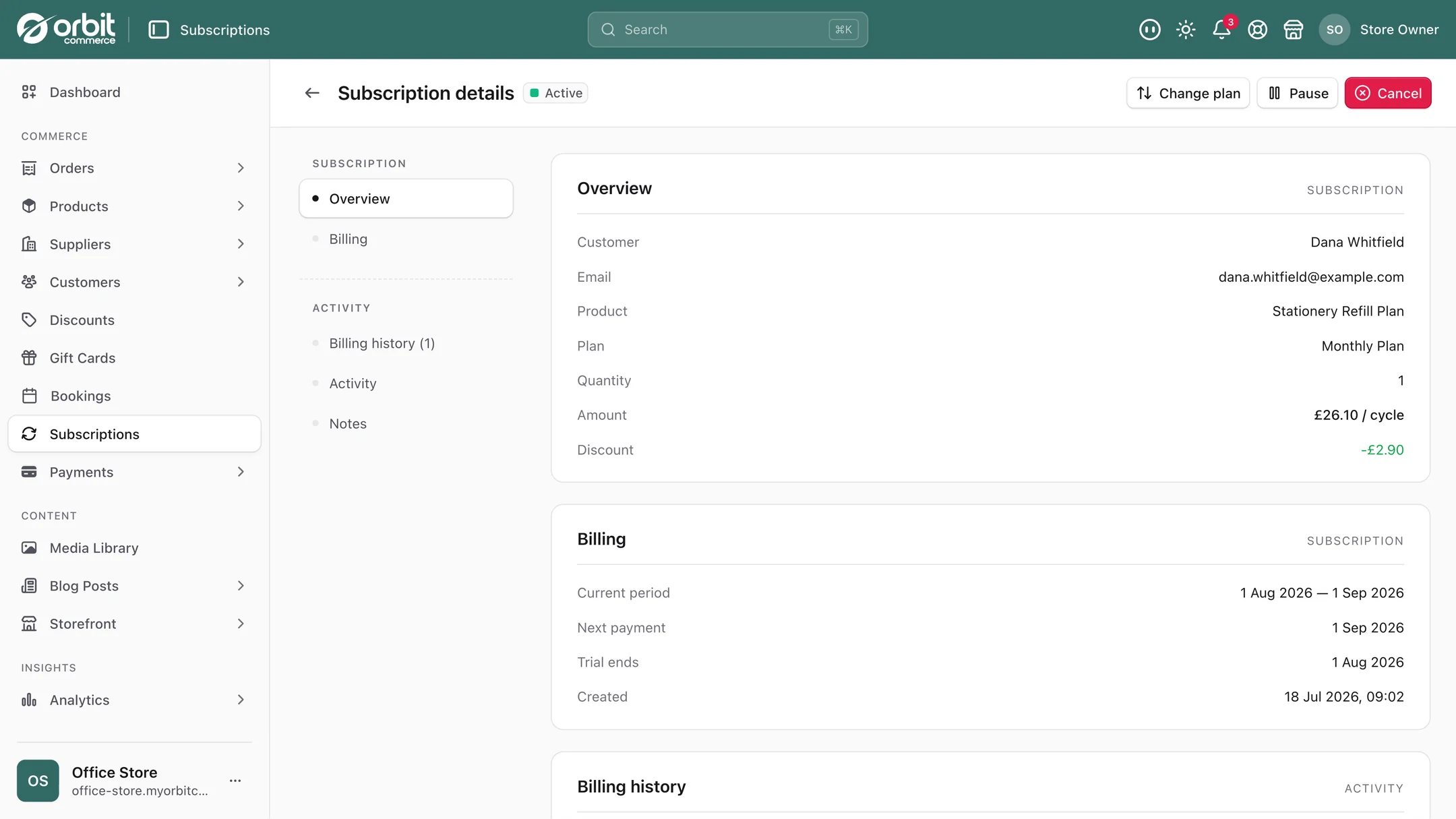
A customer subscription in Orbit Commerce showing the plan, quantity, amount per cycle, current period and next payment date
One customer subscription. What they are on, what it costs them, when it renews, and the buttons to change the plan, pause it or cancel.

The details that decide whether people sign up

Trials, free or paid. Set a trial price and a trial length per plan. A free trial takes the friction off signing up. A paid trial, say a first box at a reduced price, filters for people who actually mean it and tends to produce far better retention. Both are useful, for different products.

Setup fees. A one-off charge on top of the first cycle. This is for the starter kit, the initial consultation, the equipment, the installation. It lets you price the ongoing cycle attractively without giving away the expensive first month.

Per-plan discounts. Each plan can carry its own percentage or fixed discount, which is how you make annual worth choosing over monthly.

You can update plans without disrupting people already subscribed, which is the thing you will need on day 200 when your costs have moved.

Pausing, which is the feature that saves subscriptions

The instinct is to make cancelling hard. It is the wrong instinct, and it produces angry reviews.

The better answer is making pausing easy. Someone going away for a month, or with three unopened boxes in the cupboard, does not want to cancel. They want to stop for a bit. If the only button available says cancel, they will press cancel, and you will have lost them permanently over a temporary problem.
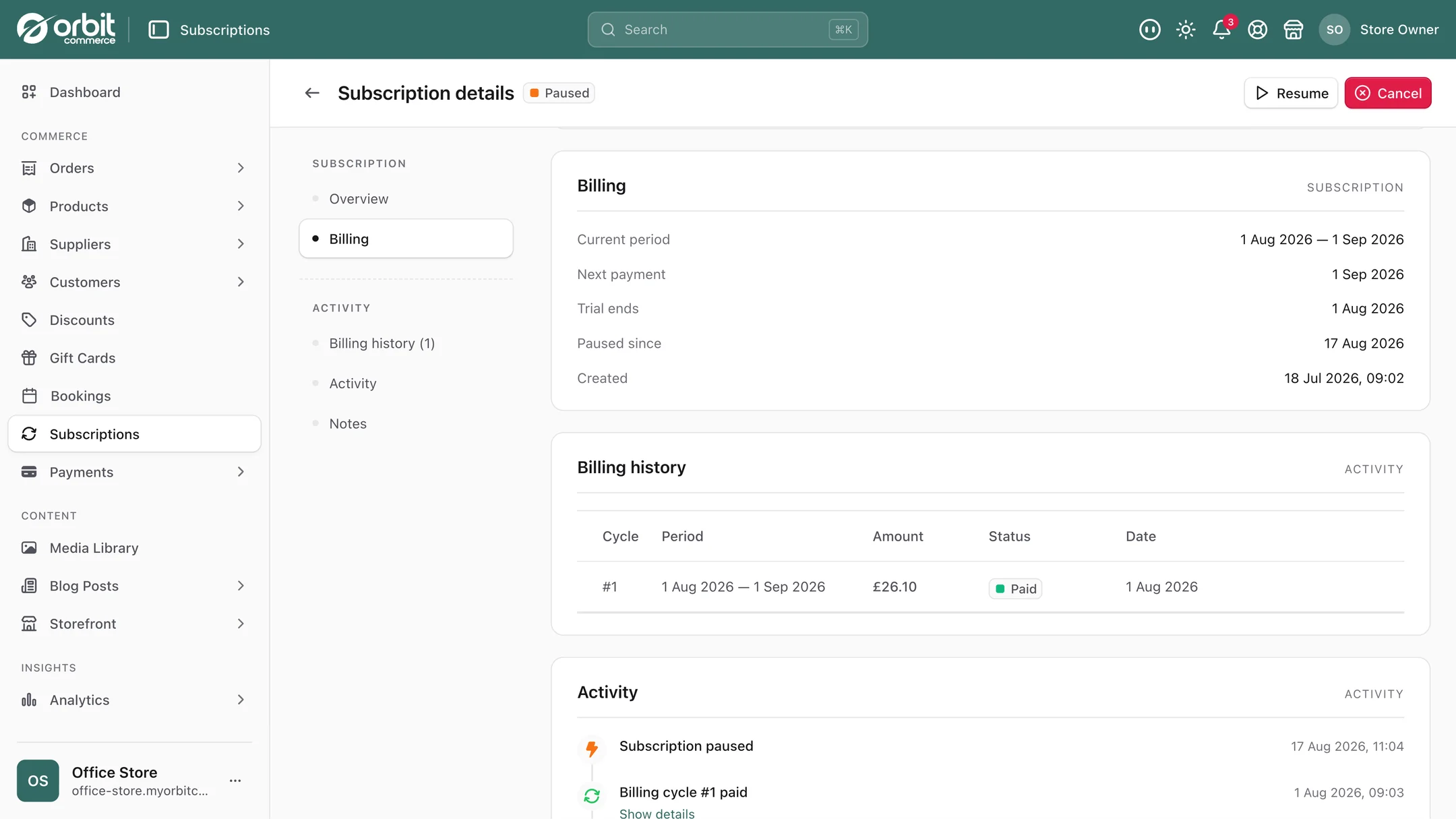
A paused subscription showing a Paused badge, a Resume button and the date it was paused
A paused subscription. The billing stops, the record stays, and Resume puts it back exactly as it was.

Orbit lets you pause any subscription from your dashboard, and cap how long a pause can last per plan so it does not become an indefinite freeze. No charges run while paused, and billing picks up on the next cycle when it resumes.

The billing runs itself

Charges go out on each cycle automatically, weekly through annual. No manual invoicing, no reminders to yourself. Failed payments are flagged and handled rather than silently dropped, which matters because the single biggest cause of subscription churn is not people deciding to leave. It is expired cards.

Every subscription is visible in one place: status, next billing date, customer details and full payment history, without exporting anything. When someone emails asking what they paid in March, that is a ten second answer.

The Payment Recovery screen showing past due subscriptions, revenue at risk, average failed attempts and a retry countdown
When a card fails, the shop retries on a schedule and shows you what is at stake while it does. Nothing needs chasing by hand on day one.

The three numbers to watch

Subscription businesses live on three figures, and Orbit tracks them without a spreadsheet:

  • Monthly recurring revenue. What arrives every month before you sell anything new. The number that tells you whether this is working.
  • Churn rate. The proportion leaving each month. Small differences compound brutally, and it is the number most people avoid looking at.
  • Trial conversion. How many triallists become payers. If this is poor, the problem is usually the product or the onboarding, not the price.

Watch churn hardest. Adding subscribers to a leaky subscription is expensive and demoralising, and no amount of marketing outruns a retention problem.

What people actually sell this way

Coffee and tea. The obvious one, and it works because consumption is genuinely predictable. Weekly for the serious, monthly for the rest.

Refills and consumables. Cleaning products, pet food, skincare, candles. If someone runs out on a rhythm, a subscription is doing them a favour rather than locking them in.

Curated boxes. Books, wine, plants, craft kits. Discovery is the product. Pausing matters more here than anywhere, because the cupboard fills up.

Memberships. A workshop's tool club, a maker's pattern library, early access. Often the highest margin thing a small brand can sell, because the marginal cost is near zero.

Trade replenishment. Your wholesale accounts on a standing monthly order, which pairs neatly with company accounts and trade pricing.

Setting up your first plan

  1. Pick one product people already rebuy. Look at your repeat orders. The answer is usually already in your data.
  2. Choose one cadence to start. Monthly, almost certainly. Add others once you know it works.
  3. Decide on a trial. Paid trials generally retain better than free ones for physical products.
  4. Add a setup fee only if there is a real first-month cost, such as a starter kit.
  5. Price the discount honestly. Subscribers should get a real reason to commit, and it still has to pay you at a lower price with postage on every cycle.
  6. Set your pause limit before you launch, not after the first person asks.
  7. Subscribe yourself and let one real cycle run before you promote it.

The honest limits

Subscriptions do not fix a product people do not want twice. If your repeat purchase rate is near zero today, a subscription option will not create demand, it will just be ignored. Look for existing repeat behaviour first.

Postage on every cycle is a real cost. A monthly box with £3.50 postage costs £42 a year to deliver. Build it into the price properly, and look at whether a quarterly cadence with a bigger parcel serves both of you better. Our shipping rules guide covers charging for it correctly.

You are making a promise about the future. Every cycle you now have to pack, in a month when you might be ill, moving premises or short of stock. That is an operational commitment, and it is the part people underestimate.

Questions people ask about subscriptions

What billing frequencies can I offer on a subscription?

Five: weekly, monthly, quarterly, every six months, and annually. You can offer a single cadence per plan or run several side by side, so a weekly plan for heavy users and a monthly plan for everyone else can sit in the same catalogue. Each plan carries its own price, trial, setup fee and discount.

Can customers pause a subscription instead of cancelling?

Yes, and you should encourage it. Subscriptions can be paused from the dashboard, and you can cap how long a pause lasts per plan so it does not turn into an indefinite freeze. No charges run while paused and billing resumes on the next cycle. Making pausing easy is one of the most effective retention tools there is, because most people cancelling would rather have stopped temporarily.

What happens when a subscriber’s card fails?

Failed payments are flagged and handled rather than silently dropping the subscription, and every subscription shows its status, next billing date and full payment history in one view. This matters more than it sounds: expired and failed cards, not deliberate cancellations, are the largest single cause of subscription churn for most businesses.

Should I offer a free trial or a paid trial?

Both are supported, with a trial price and length set per plan. As a rule of thumb, free trials maximise sign-ups and paid trials, such as a discounted first box, produce noticeably better retention because they filter for genuine intent. For physical products with real cost per box, a paid trial is usually the better economics.

The short version

Start with one product people already rebuy, one cadence, and an honest price that survives postage on every cycle. Make pausing easy and cap how long it lasts. Watch churn harder than you watch sign-ups. And remember you have promised to pack this every month from now on, which is the real commitment, not the software.

What this saves you buying

On most platforms the things above arrive as separate paid apps. On Orbit they are part of the plan. Typical add-on prices, for comparison:

What you would otherwise buyTypical cost elsewhere
A subscriptions app£20 to £60 a month, sometimes plus 1% of subscription revenue
A separate recurring-billing tool£25 to £100 a month
Manually invoicing regularsan evening a month and some awkward reminders

Third-party prices are indicative and move around. Check the vendor before you budget on them.

Free to start

Launch the store you’ve been meaning to build.

Free to start, fair to stay, and built by people who have been in your shoes.